Chief Executive at Escape to Make (E2M)
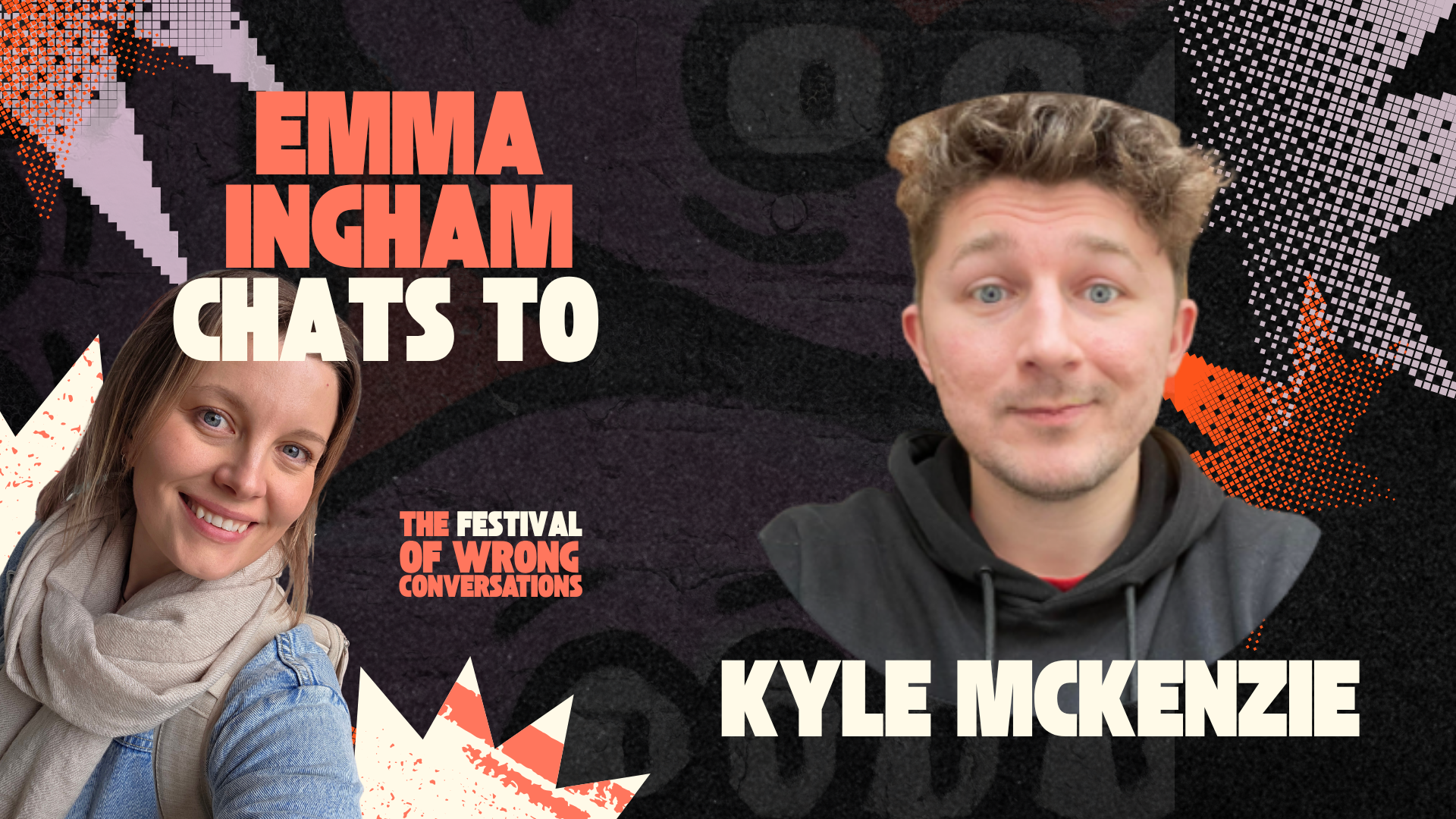
For this conversation, I was joined by Kyle McKenzie, Chief Executive of the wonderful youth charity Escape 2 Make (E2M).
Kyle brings incredible energy and a unique, insightful window into the world of youth-led co-design and the creative arts. His energy is contagious - and coming from an arts and humanities background myself, and being a relentless champion for creative health infrastructure, I quite simply LOVE everything E2M stands for.
We have a long chat about the very real, transformative power of tactile creation, and how building things with our hands grounds us in a world full of noise.
In this episode, we discuss the work E2M is doing alongside local young people and teenagers, and explore why true youth-led co-design leads to better, more welcoming spaces for all of us. We talk about scrapping cold clinical design and pricey tech ‘gimmicks’ for simple, low-cost, cosy vibes, and why screen-free creative outlets are vital for mental health today.
Grab a coffee, settle in, and enjoy the conversation.
The longer read
(Grab yourself a coffee)
Not enough time? Find a snapshot of our conversation here
Emma: Good morning. Kyle.
Lovely to see you and thank you for joining me today. Please could you introduce yourself, tell me what you do, and then describe your role in three words
Kyle: Sure. I'm Kyle McKenzie and I'm the Chief Exec at Escape2Make (E2M).
We are a youth charity that put on creative workshops and events for 11 to 18 year olds to try and encourage them to embrace creativity. That can be an opportunity to try something that they've never done before, or it can be an opportunity to build up skills in a certain creative practice. For some young people that is about opening doors for the future career opportunities, or further education. For others it's about making new friends or meeting like-minded people. And for some young people it's about vital mental health and well-being support. It might be the only opportunity they get to be in a space with other people to be able to express themselves and to feel better about themselves.
So we are, and can be, a number of things to different people.
Everything that we do at E2M is completely free for all 11 to 18 year olds to get involved with - and we would encourage any 11 to 18 year old to get involved, because I've not met a single person in my life that I don't think would benefit from creativity in one way or another.
There’s no hidden costs. There's no subscriptions. You don't have to commit to anything with us. But we really encourage young people to try new.
And if we find that magical moment where teenagers try something for the first time and you see that confidence develop in them when they realise, ‘I'm quite good at this’ or ‘I've really enjoyed this’. And if you can do that in a safe environment, and in a welcoming space - where there are other like-minded young people around, and really strong role models and mentors, and artist facilitators - it's just a wonderful thing to witness and be a part of.
So that's our goal at E2M - to help young people unlock their potential by offering them free accessible creative opportunities.
Kyle: Um, so to summarise in three words what I do… Creativity would be number one. Kindness is number two. Opportunity would be number three.
Emma: Nice, thank you.
What does a healthy space mean to you?
Emma: Okay, so moving on and thinking about healthy spaces. What does a healthy space mean to you? Have you been in one? What does it look like, feel like? Smell like? Where is it? Just talk me through what healthy space is to you.
Kyle: I mean, I might be a bit biased, but I believe E2M to be a healthy space. It’s one of the healthiest spaces that I have ever been in, and I've had the pleasure of helping to develop.
And ‘healthy space’ means different things for different people that utilise the space.
So, for myself and the rest of the staff at Escape to Make - we love our jobs. We love working here. We love coming in and doing what we do. And a big part of that is because of the environment that we've built within our centre and the way that we work together to support each other - there's a lot of psychological safety in the workplace, and I encourage the rest of the team to question things and to come up with ideas and they'll never not be listened to. So we've built this this culture at Escape to Make that is really supportive, friendly, and very much creativity-led.
I guess in terms of the physical space - and when I think about what a healthy space looks like for young people - the most important thing is that it is youth-led. I think that the mistake that some people make is deciding for young people what they want, but young people have so much to bring themselves.
They’ve so many brilliant ideas that we would never think of. They're so clever, and expressive, and intelligent - they're far more intelligent than a lot of people give them credit for. If you can give them the right platform - or the right opportunity and environment to express themselves in - they will be able to tell you what they want, and what means something to them.
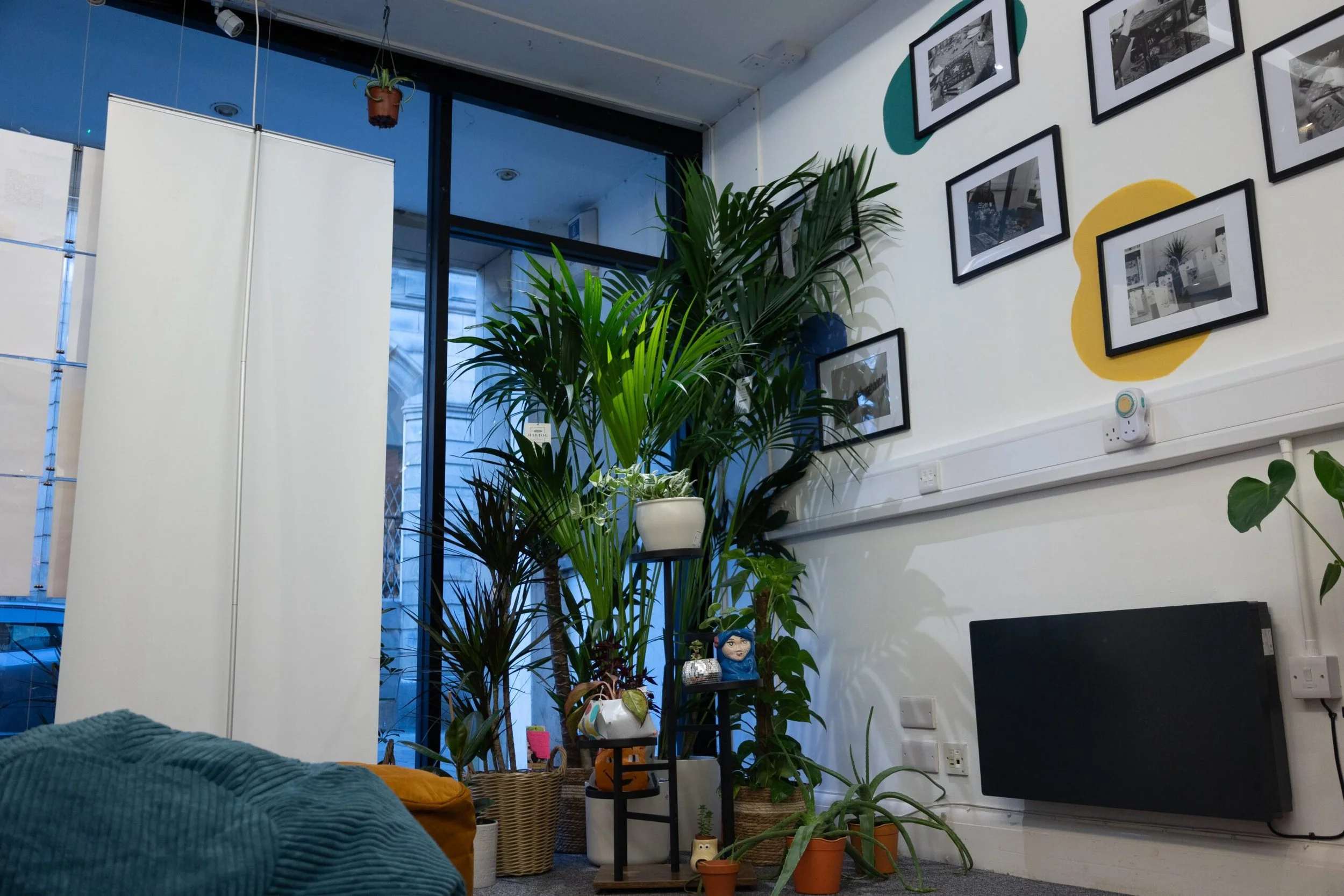
So physically, E2M is a colourful, vibrant space where young people's work is at the forefront -you can't walk in without seeing any number of art pieces that that young people have created. They've got fun, funky ideas like putting a disco ball into the space.
Then they've got really practical ideas like the way we’ve separating our centre - with half of it a comfortable seating area with bean bags and sofas, and the other half is hard floor for messy workshops where we do our pottery and paints and all of our messier things that we wouldn't want to sort of mess up the other half of the space with. But these are all things that come from the young people.
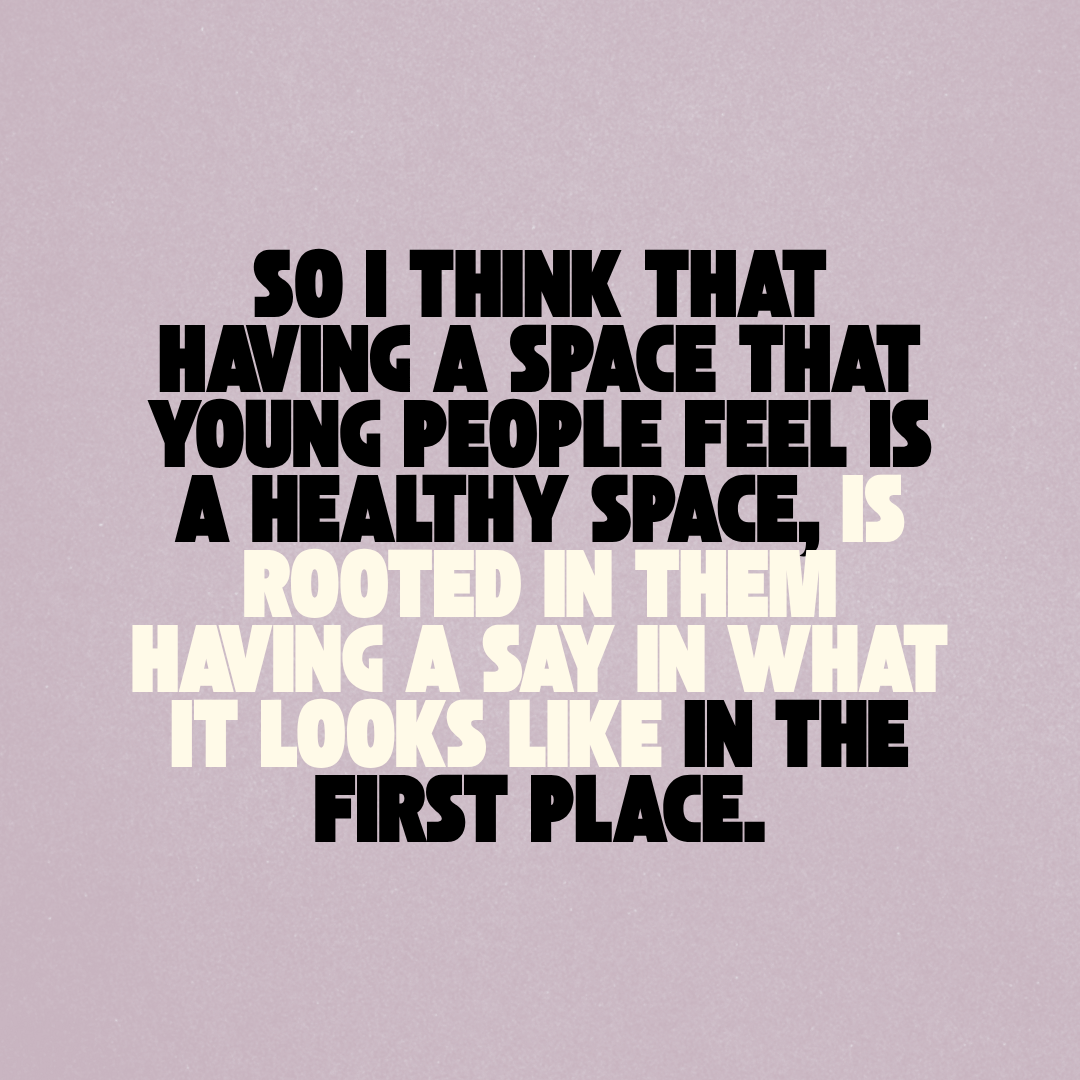
So I think that having a space that they feel is a healthy space, is rooted in them having a say in what it looks like in the first place.
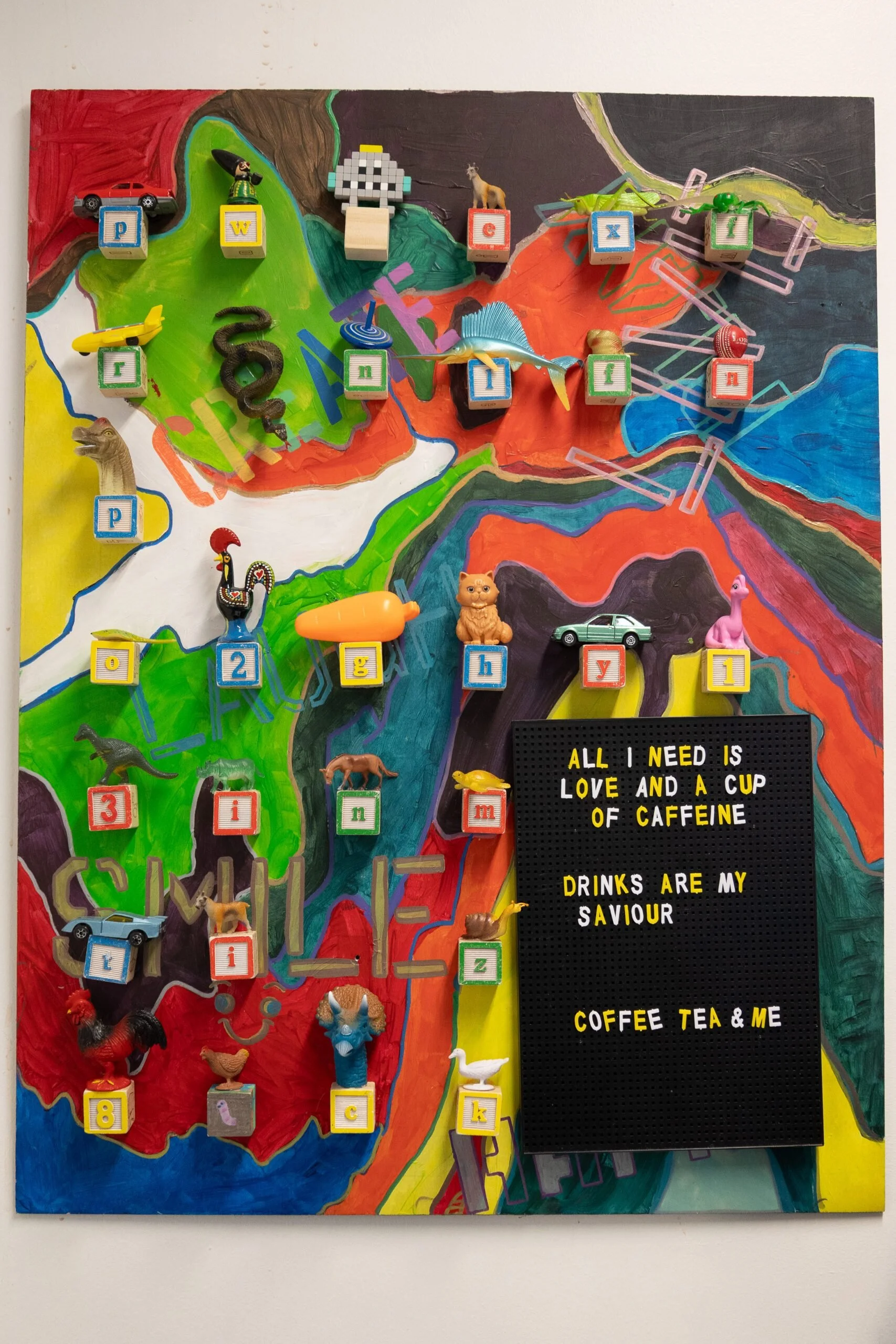
The E2M Centre, Lancaster
Emma: Yeah, it's really interesting because it feels very much like for you that the idea of a healthy space is embedded in the feeling and the culture of that space - and then it’s that in turn that translates into the physicality of the space, rather than it being the other way around.
Kyle: Yes. But it is cyclical because the more ‘healthy’ a physical space that you can create - you know if it's got natural lighting, and it's bright, and colourful and all that - it's it helps make young people feel more at ease to be able to express themselves to be able to create that culture that then they can say what they want that then to improve the physical space.
Emma: Yeah, totally.
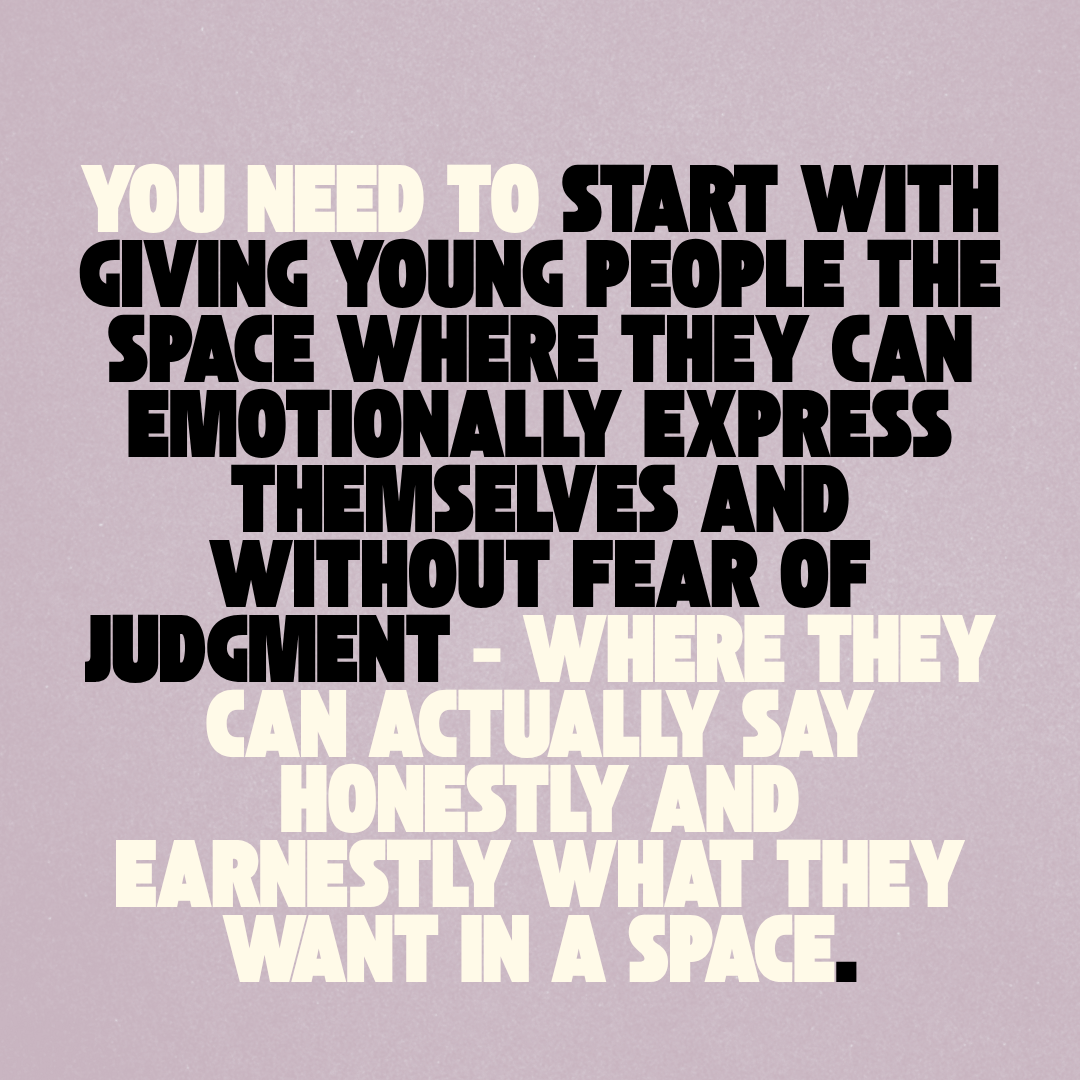
Kyle: You need to start with giving young people the space where they can emotionally express themselves and without fear of judgment - where they can actually say honestly and earnestly what they want in a space.
Emma: Yeah. Wonderful.
What one thing should we stop doing today to improve health by 2040?
Emma: Okay, let’s move on. If we are going to build a healthier society by 2040, what is the one thing that you think we could should completely stop doing today? Not something that we just reduce, but stop. If there was one thing that you would love to see people, society, and individuals stop doing, what would that be?
Kyle: So, it's a difficult one. I think that there's a few things.
I had the power to stop something today that I think would benefit people going forwards, it would be the way in which young people, and adults, use social media.
That’s not to say remove all social media because I do think that it's a very valuable asset to allow people to communicate - it's really helpful in the workplace, great for families that live long distance from each other and it can be a really good tool for maintaining friendships as well.
However, I think that uh there's something really damaging that comes along with being able to be connected with anyone across the planet at all times, and to have the sort of the world at your fingertips constantly.
Emma: Yeah.
Kyle: To have all the big national, social, political, economic crises of the world available at a glance at any point during the day for anyone of all ages - it's a scary thing. When you look at the power that young people have in their pockets to be able to like access all of the of the world's difficulties at once.
Emma: Mmmmm.
Kyle: And unfortunately, this is something that I don't think will ever change, but there are people out there that are keen to profit off, and take advantage from global situations that then have introduced fake news and fearmongering - and it puts a tremendous amount of pressure on all people, particularly young people.
And this sits across all parts of the political spectrum by the way - it's not just sort of a ‘one side versus the other’.
There are people online that will say something with complete confidence - in reality, what they're presenting is completely unfounded or false, yet presented as if it were fact. And it's a really damaging platform then for young people to be able to have access to that sort of thing - especially at a time where they're in their formative years. When they're making opinions of their own and they're deciding where they fall into sort of socio-political questions and dilemmas – online is a tumultuous landscape that that unfortunately I think that young people get caught up in too early.
It’s hard at the best of times to be able to spot whether something is fake news or accurate, or in the last year or two as well, whether something is AI or not - and all that’s only going to become harder and harder as time goes on.
So I think that if I could stop anything, it would be young people's access to these sorts of things on social media. Or in an ideal world that people weren’t able to present things on the internet as if they were fact with no basis behind what they're saying at all.
Emma: Building on that idea around social media – can we pause and think about the fact that we all have everything and anything available to all of us, all of the time, all at our fingertips. And consider what it means that in terms of creativity – both in expression of creativity, and then more broadly around creative thinking. What’s your view on social media stifling expression and creativity versus being an inspiration?
Kyle: It depends who you ask, and it's different for different people. I think that there are definitely benefits in social media, because there are platforms where people can share work that they've done, or be inspired by other people's work.
You have an endless library of artworks created by some of the greatest artists of all time - as well as all those artists whose names aren’t known - available at your fingertips. So, in some ways, you have this vast, everlasting library of inspiration to be able to tap into, which is wonderful.
Emma: Yeah.
Kyle: Then also for sharing your work, having a platform to be able to stuff out there.
Emma: Yeah.
Kyle: That doesn’t come without problems, but something like Spotify for musicians gives musicians the opportunity to put their work out there for absolutely anyone and everyone.
And 50 years ago, that would have been a completely foreign concept uh like to be able to make something and then instantaneously share it with everyone. So I don't want to discount the tools it has given people.
However, I do think that social media and the internet have had a tremendously negative impact on creativity. Especially in that there are there are platforms that have been created that are designed to shorten attention spans, and to suck people in to suing an app or website for as long as possible – all for engagement, engagement, engagement. And that is pulling them away from things that they might have been able to make and create.
It’s quite alarming sometimes to see really young kids on phones or iPads. Decades ago, without these devices, parents handed children pens and crayons and paints to keep them busy and encouraged them to create. Now, giving them a screen is a ‘play thing’ - and it ends up exposing them to short attention spans, fake news, or worse.
Technology has clear pros and cons, but in the end, it all comes down to how we choose to utilise it.
Emma: Yeah. Thank you.
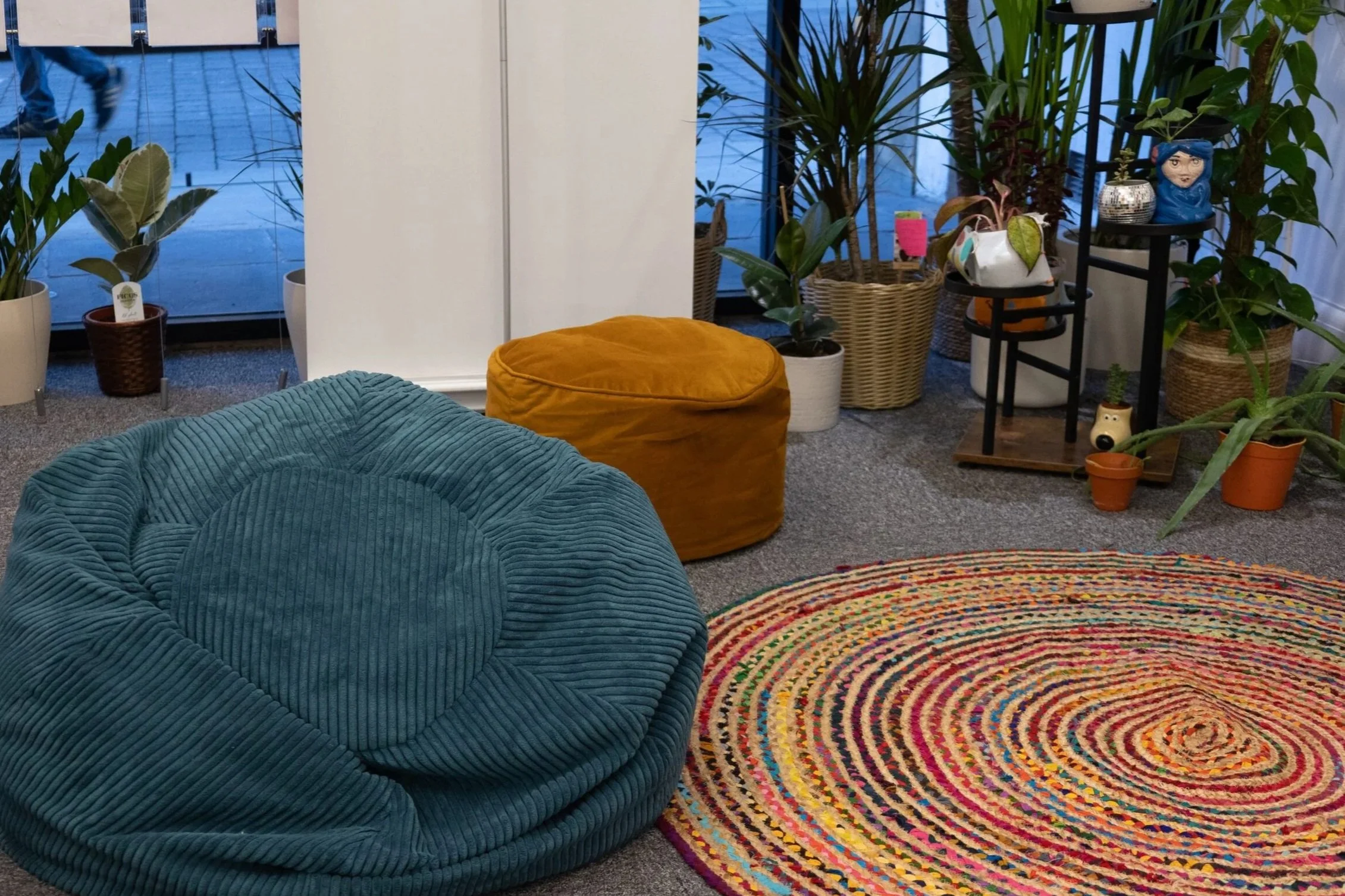
The E2M Centre, Lancaster
If you could give someone outside the NHS a budget to do something with a space, who would you give it to, and what would you want them to do?
Emma: Okay. Thinking about then budgets - if you had the opportunity to hand a chunk of NHS budget to somebody who sat completely outside the health system to do something with a space, who would you hand it to and what would you want to see them do?
Kyle: I would give it directly to the 11 to 18 year olds that are on our E2M youth board. Our youth board is a group of young people who steer our organisation - they make all of the big decisions about what we do, what our values are, what our code of conduct is, who we work with, what sort of workshops we do, what sort of delivery we do.
They help us shape the identity of E2M and they have co-designed the space that we deliver in. So they have made all of the decisions about the colours to paint the walls, the fixtures and the fittings in the centre. They determine do we have chairs, sofas, bean bags? Is it carpeted? Is it hard floor? What should the flow be like when we walk into the space? What should it smell like? Where do you want people to hang out? Where is a place where young people shouldn't access?
They are so thoughtful in terms of how they would use a space. I think that if they had unlimited means to be able to shape a space of any size or scope, I think that they would honestly make the most welcoming, creative, safe, fun space for all teenagers to come and access.
Giving that power directly to young people is really important.
Our youth board recently were shortlisted for a national arts and education young activism award. So um they it's not just me saying it - they've genuinely been making a real difference and their decisions have led to hundreds of young people coming into our centre and feeling at home. And that's something that I don't think would have happened if we'd just made all the decisions ourselves.
Emma: Yeah.
Kyle: Um, having that diverse range of voices and perspectives has been so valuable to us and I wish that we could just give them any amount of money to be able to do it on a bigger scale.
Emma: Thank you. That flows nicely into the next question then…
Emma: You are quite unique because you have created a space where young people have been at the very heart of directing the design, rather than being ‘engaged’ as a group after you know a large chunk of the design work has been done.
From your experience of working with the young people, and designing the space that you're in and other work that you've done - what is the thing that young people ask for all the time or have asked for that surprises you?
Then, what do you think then that indicates about what they're missing more generally in public spaces? What might be missing in more general design of places and spaces that young people would like to see in your view?
Kyle: Yeah. Well, I'm constantly surprised by how shocked and happy it makes our youth board when they suggest something and then they see it actually happen. When they see that their discussion and their opinions have been taken
There are always any number of opinions that come along with designing a space with young people - and with adults. Some people will want one thing, some people will want another thing. So it's not quite as easy as saying - this is this is a design choice that that comes up regularly that that that young people say that they want.
It's more that um when young people see the effect of the of their discussion being implemented, they are pleasantly surprised because that doesn't happen very often.
Emma: It's really sad that, isn't it? That shouldn't be the case, ever.
Kyle: Absolutely. It's quite shocking and I've been to a few of these sort of consultations with young people for various things in the past that that feel a little bit tokenistic and feel like um someone said, ‘Oh, you know, for a funding bid, we need to consult with young people, so we'll make sure that we do this meeting to say that happened’.
But none of what the young people have discussed has gone anywhere - it's been logged in the meeting minutes and it will sit on a Microsoft SharePoint file forever!
Seeing a young person's face light up when they've said it'd be really great to put a mural here on this wall, and then the next month for them to come in and see that there's a mural there – they feel like ‘wow you listened to me.’
Kyle: So it’s not just listening to their ideas, but it's the follow-up that that really makes a difference. It's the going away after and doing something about it and making their voices heard.
Sometimes there are certain things that come up that you have to go back after exploring something, and there might be reasons why we can't do what you've suggested and I think that's an important part of the process as well.
Are young people’s views reflected in civic and health spaces?
Emma: From your perspective and work with young people, do you think general public and civic spaces ever truly consider youth needs, or are they just low on the pecking order of consultees? Because to me, that usually feels like it is the case.
Kyle: No, totally. I completely agree. I think that young people have been an oversight when it comes to um public use buildings, and in designing things that should be for everyone – but actually don't really work for young people all that well.
Emma: Are there any non-youth-specific spaces you've seen where young people actually felt genuinely welcomed?
Kyle: We did a piece of codesign work actually with our local museum recently - we work with Lancaster City Museums fairly regularly on heritage based and creative projects together. Having seen what we accomplished with our Escape to Make (E2M) space and how well young people respond to it, they wanted to update some of their more traditional displays using recent redevelopment funding. They were keen to have young people's voices in the planning process, so they partnered with our youth board to co-design what the city museum should feel like. They also reached out to several other youth groups and organisations across the local area to ensure they gathered input from a broad pool of young people.
Emma: Great.
Kyle: I think that's a really refreshing move in a positive direction - particularly when you're thinking about museums and heritage sites, they more than anyone seem to struggle with engaging young people.
And there are museums that do it really well - you don’t have to go too far to museums like the Tullie in Carlisle for example. The Tullie is a place when you walk in you feel like ‘this is such a cool space’. And I feel like if I brought some kids along, they would absolutely run around and go wild engaging with everything, because it would it would feel like a space that is designed with them in mind.
So the work that Lancaster city museums have been doing with our youth board is in an effort to make their space feel a bit more like something that was made in response to their young people’s whims and wishes and uh how they would use the museum. So I do see pockets of co-design work like this that champion youth-led design - and young people have incredible intuition when it comes to shaping these kinds of public spaces.
I really wish that there were more organisations and more public spaces that thought like that that would listen to young people and encourage them to have their say in how spaces are designed.
Emma: Really interesting. I’ve more questions that follow on from this!
How engaging are ‘engagement’ methods? And do we value the views of the adult population of tomorrow?
The first is on engagement methods. Do you think the tools traditional design processes use to consult young people are actually engaging, relevant, and accessible to them?
Secondly, I am thinking about long-term design. Because young people aren't just ‘youth’ - they’re the future adults who will inherit these spaces that the current adult population are designing for them.
Do you reckon design industries fail to realise that asking an 11-year-old what they need isn't just about designing for children today, but about predicting what they’ll need when they’re 30? Or 50? What somebody who's 11 today is going to want when they're 30 is going to look very different to the sorts of space that I would have wanted when I was 30, or to that that someone who's 50 now wanted when they were 30.
How do we shift to seeing youth as the future generation shaping long-term public space, rather than just a temporary demographic?
is actually engaging? And then what are your thoughts on you know thinking about young people as actually the future generations who should just be influencing design regardless of whether it's for young people today or in the
Kyle: Okay, so I don't think that the tools that uh are used typically to engage with young people in co-design are that effective. No, I think that we have to do quite a bit of work to do.
As E2M whenever we do a bit of co-design with young people, it is not as simple as saying fill in a Microsoft form together. What we do feels like a really creative exercise – lots of discussion, mocking up plans and ideas with string to understand space and scale and layouts.
And you need to really be able to design activities and create environment that encourage them to open up and to speak honestly and openly about what their thoughts are as well.
Young people have so many ideas and so many great suggestions, but sometimes you do need to have to be able to tease it out of them. We also must remember that we have a generation of teenagers who are highly anxious, and some of them have real difficulty with speaking in front of a group of strangers. But that young person might have fantastic ideas that they want to keep to themselves because they got they have a fear of being judged or mocked because of their suggestions. So you have to find ways to be able to overcome that, and navigate around that, and create the space so that that young person can have their say- then you end up with authentic youth voices
Emma: Yeah.
Kyle: It’s really not as simple as just gathering people around in a on a table and discussing what good ideas you have!
Kyle: In terms of the second part of what you said about like future-proofing spaces - I think you're absolutely right because we're talking about the generation of tomorrow, and it matters in so many ways.
Let’s say for example that young people are consulted about their local museum, and that museum implements changes that are suggested by the young people. As those young people grow into adults, they are more likely to use the museum because they feel ownership over it. And then eventually one day they'll bring their kids to the museum, and perhaps by that point the museum might start to feel out of date out of date again. Then you talk to the kids about all right well what would you like…
Then you create this cycle of improvement and making sure that these sorts of spaces are always going to be accessible to the next generation of people.
Emma: I'm going to jump to another question, because I think it leads on quite nicely.
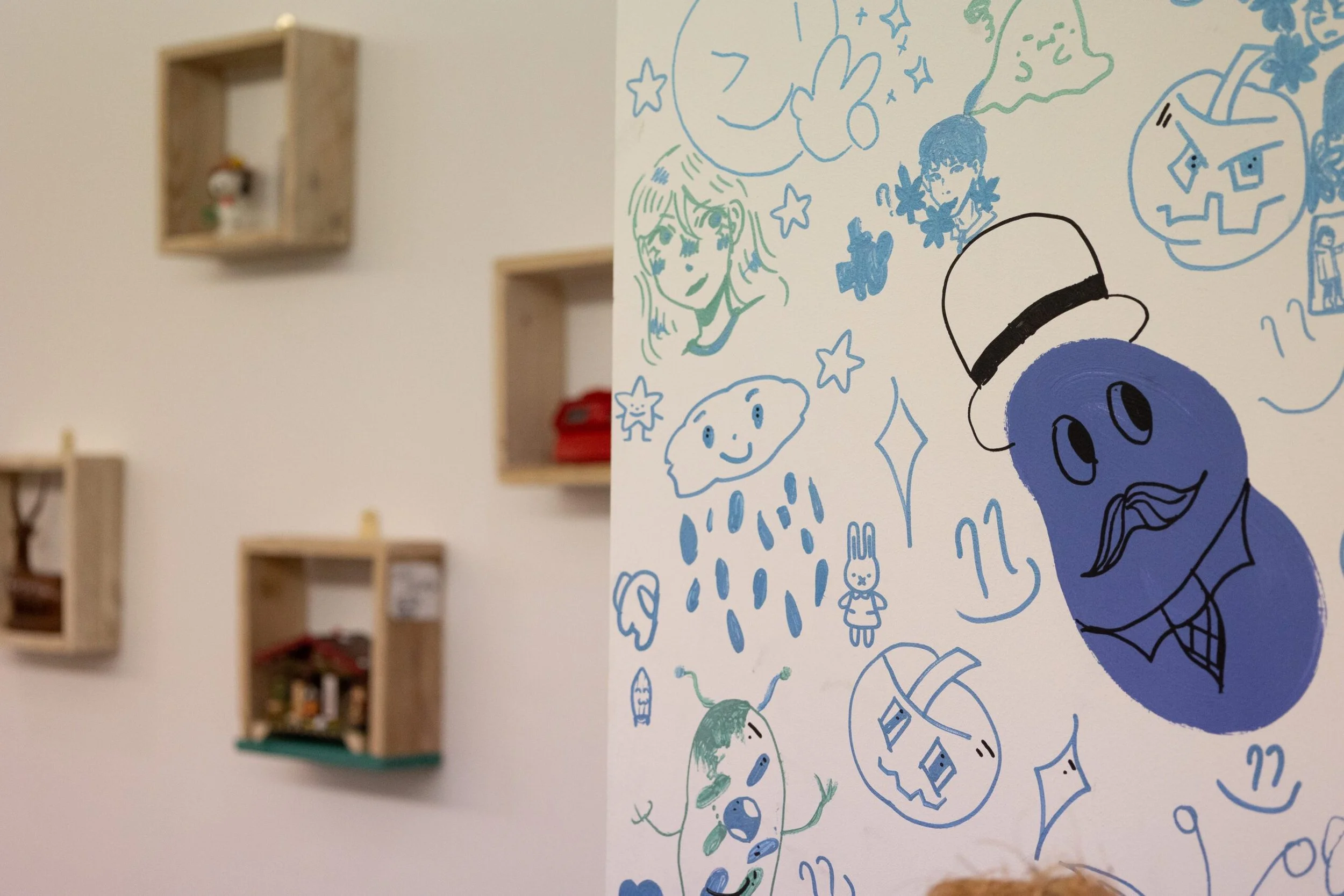
The E2M Centre, Lancaster
What do you think young people would build if given a blank sheet of people to shape a health space?
Emma: If the NHS commissioned the E2M youth board, and your wider team, to design a space for young people's health and well-being, what do you think you might you build? What do you think that your young people would want to potentially see? How do you think it might look and feel different maybe to some of the health spaces that we're more familiar with?
Kyle: I think one thing that has shone through when we've talked to young people about space is that they want to avoid something that feels like a classroom, and they want to avoid things that feel too clinical.
I think that that that is the risk with designing a health and well-being focused space is that it does feeling clinical.
And naturally you might want to have um like some a chair, and a desk, and a bed, a notice board with information on it. And I think if you're if you're an adult, you're thinking - well, it makes sense to have this list of things in that space for a doctor.
However, if you gave the reigns over to young people and say ‘what should the space be?’, I bet you you'd hear quite a different view, because I suspect they would be avoiding your archetypal therapist's office or GP's office, or ‘classroom’ feeling space.
Because young people see enough of those spaces. And they also feel like they tired of being test subjects, and guinea pigs - and they don't want to feel examined.
It’s why I think a space that looks quite a lot like the E2M space is actually an ideal design for a health and well-being centre, because it's a space that the young people have created themselves. It's somewhere they feel comfortable and at home, it's colourful, and it's a space where they can feel at home without feeling like they're being monitored and examined.
Emma: Yeah.
Kyle: Uh and I think that that actually is probably the most useful advice – is to create health spaces where people feel comfortable. I can imagine that young people might not feel so comfortable in a space that feels too much like a doctor's office.
It’s interesting thinking about making a space comfortable. When we ran a co-design session with young people a couple of months ago, we asked them to spend 5 or 10 minutes writing every idea they could think of on post-it notes - we got everything from lockable doors to felt art and light-up dance floors.
Then we mapped them on a wall grid - ‘Want to Need’' horizontally, and ‘Important to Unimportant’ vertically. A disco floor is a ‘want’, while a lockable door is a ‘need.’ But what was fascinating was that the things highest in overall importance were the elements that made the space feel safe, welcoming, and inclusive. It was about the vibe and the energy.
Emma: Yeah.
Kyle: Basic infrastructure like walls or windows scored high on ‘need,’ but they weren't as high on ‘importance’ as a beanbag area where people could sit and chat. What mattered most to them were the cosy, human touches that made the space feel good to be in – all the things that made the vibe and energy of the space human.
Emma: What's so funny though about that is all those things that you describe some - not necessarily kind of the specifics, mirror balls and bean bags - but wanting all of those things that make a space feel welcoming and comfortable and make you feel like you belong in that space and you feel safe in that space, they're just universal.
Kyle: Yeah.
Emma: As adults, we just sort of accept that a GP's office looks a certain sterile way. But when you open up that design conversation to young people, they focus on elements that make the space feel comfortable, welcoming, and safe. And the reality is that youth-influenced design ends up simply being great design for everyone - anybody walking into that space feels automatically more at ease. There’s just so much for the design world to learn from these conversations.
Emma: It is also with saying that a lot of what you spoke about it's not expensive stuff -we're not talking about loads and loads of money with these little things that make a space feel human.
Kyle: No. Absolutely.
Emma: These really important things often do not cost a lot of money at all. Something I think we tend to lower their importance because we view cheap items as optional extras with lower value, but we're blinkered to the fact that those small, affordable choices actually make the biggest difference in a space.
Kyle: It’s a trend that we've seen a lot when we do these sorts of exercises with young people - the things most important to them are actually very cheap, and they genuinely want offline opportunities rather than screens and devices.
That’s a huge distinction between designing a space for young people versus with them. Adults often assume kids want hip new technology, screens, and games, but we almost never hear that from them. What actually comes up time and again are plants, paint, and natural light - the simple things that make a space feel cosy and like home.
Emma: Yeah.
Does the health system value the power of physical making enough? Are we at a point of change?
Emma: To bring things full circle, I want to talk about the physical act of making.
But first, I’d like to say I just love and admire what E2M does, and stands for. I come from a literature and storytelling background, so while I might not be a particularly skilled hands-on maker myself, I’m deeply passionate about the power of creation. And seeing what E2M have created with, and for, young people is incredible – it’s a wonderful thing to see, and I’m so glad it exists.
So my question…
In a world where so much of life – let alone art and creation – seems to happen through screens and digital tools, there is still immense power in physically creating something with your hands.
From your perspective, how does the act of making directly connect to health and well-being? Why do you think it has taken us so long as a society to recognise that value, and do you feel we’re finally at a turning point where the power of making is being taken seriously?
Kyle: Yeah. I think that that there is a growing emphasis on it because there have been programmes over the last few years that have really helped to utilise creativity for well-being. There's been a lot more in terms of academic studies. Daisy Fancourt's book ‘Art Cure’, has really delved into how art can be used as a tremendously valuable tool to be able to make someone feel better and to improve their well-being.
Take a look at NHS services that are focused around well-being, particularly Child and Adolescent Mental Health Services (CAMHS) working with young people - there are waiting lists that take years to be able to access support, which is really worrying for people. But some of the work in in recent years that that that CAMHS have been able to do in implementing creative practice into their delivery strategy has shown to be really effective. The i-Thrive model run in Greater Manchester last year, I believe implemented creative practice into well-being delivery - there are several children's and young people's mental health services around Greater Manchester that now embed creative work into mental health and well-being services for young people, which I think is fantastic.
It's something that's developing and growing, and something that E2M can help with a lot as well. We are a fantastic resource for anyone who is on a waiting list, or receiving support, or waiting to talk to someone. There is real value in being able to engage in some form of making, and crafting is a fantastic way to rediscover yourself, discover new skills that you might not have realised you had, or old skills that you've forgotten that you have.
You might have 10 young people at a pottery class, all from different walks of life, all different ages, varying genders, ethnicities and backgrounds, household incomes. But the young people in the session, they just know that others are here because they’re also interested in pottery. And then before you know it, people start a conversation - lots of creative activities are fantastic activities to do to be able to make and talk at the same time to get to know someone.
Emma: Yeah.
Kyle: And that's how you can get talking to someone that's from a completely different life, or background, or who has a very different story to you. It helps young people build emotional intelligence and awareness of the fact that there are different people out there, and that some of the information you’ve been told, or heard from others, or online, might not be true at all.
And creativity has the very real power to be able to aid in that. I feel very fortunate that we see that at E2M pretty much every day - where young people come in and use creativity as a tool to improve their own well-being.
Emma: You have a wonderful job.
Kyle: Thank you.
Emma: You really do.
Kyle: Yeah, I I do love it. It's great.
Emma: Just one final thing - do you think from what you have observed, that there is enough creative thinking in the broader sense in across public services?
Kyle: Hmmm, it's a difficult question.
There are so many people out there doing great creative work - fighting tooth and nail, and fighting the good fight. They are tremendously creative people trying to make change, but they might be surrounded by teams of people who don't share that same motivation.
So II don't think it would be fair to say that like in the public sector there's not enough creativity, because there are there are wonderful people out there that are really trying to make a difference.
That being said, I think that there's always more that you can do. There's always progress that can be made and creativity is such a wonderful tool that you can apply to any sector, any workplace, any situation that you're in. Creative problem solving is something that applies just as much to pottery, as it does to coding, as it does to selling a house, to any trade or public service delivery. So realistically I think that creativity is something that everyone should be able to benefit from.
You can do almost anything with creativity, but like I said earlier on - I've never met a single person in my life that I don't think would benefit from introducing more creativity into their lives.
Goodbye and thank yous
Emma: That feels like the perfect place to end the conversation. Thank you so much for your time um today. It's been great, and I really appreciate you taking some time out of your day to chat.
And next time I’m in Lancaster, I would love to pop in and see your space.
Kyle: Yes, please do. Yeah, that would be fantastic.
Emma: Lovely. Nice to see you again. Have a lovely weekend.
Kyle: Bye. Talk to you soon.
Emma: Thanks, Kyle.