A conversation with Dr. Aisling Rusk
Founder & Architect, Studio idir -Belfast & Dublin
For this conversation, I was joined by Dr. Aisling Rusk – founder of Studio idir, based in Belfast and Dublin.
Aisling’s work sits at the intersection of spatial practice and design, with a particular focus on building connection, especially in places that have known division. It is something she talks about quite beautifully.
Join us for a truly fabulous conversation where we chat about projects bringing people together across Belfast, the jarring juxtaposition of experiencing beautiful spaces in a world full of smart phones and social media, and the raw, under-exploited radical power of walking as a way of connecting places and people.
I absolutely loved talking with Aisling - the part where we chat about walking opened my eyes to a whole new perspective on one of my favourite pastimes.
I hope you enjoy it as much as I did.
The longer read
(Grab yourself a coffee…or a drink of your choice)
Not enough time? Find a snapshot of our conversation here
Emma: Good morning. Lovely to see you today.
Aisling: You too.
Emma: Okay, perfect. Please could introduce yourself, tell me who you are, what you do, and then describe your work in three words,
Aisling: I’m Aisling Rusk. I'm Director of Studio idir architects in Belfast. I have a research background, and a PhD around exploring connection across division and spatial practices that build connection, where there has been division. And I'm a mother of three kids ranging in age from almost 2 to 12.
Three words is hard to do but I think my three words with a bit of a stretch are: ‘problem-solving’ - spatial problem solving is what I do. Then ‘connections’ - I make connections. Finally, I look out for the ‘overlooked’.
Emma: Great.
Aisling: So three words - problem-solving, connections, and overlooked.
Emma: Thank you very much. Really interesting words.
What does a healthy space mean to you?
Emma: Okay, moving on to the questions. First question is - what does a healthy space mean to you? Have you been in one? What does it look like, feel like? Just talk to me about healthy spaces.
Aisling: I think a healthy space, whatever scale it's at, is about an absence of barriers in use and an absence of irritants. It’s about variety and options adaptability - so you can use it in different ways according to your ability, or your mood, or your need at the time. It has moments of joy and pause.
And I think a healthy space is one in which you can see and/or be seen as much or as little as you wish. You know, you could be in it and be under the radar, or you could flaunt yourself in it if you felt like it. You can sit and people watch, or be watched.
I also think it's a space where you have connection to nature and connection to history or culture or a sense of place in some way.
And I thought a lot about an example and the best example I could come up with is one that’s on the city scale - the city of Edinburgh. I think that as a city it's a really nice size - you can get out of it and into it easily enough. It's not huge, and it has heritage and nature right there in the heart of the city. It's a really layered space, with multiple hubs and centres.
When I lived there and walked to work – it was easy to do across the city. There were lots of people walking and crossing paths with me who lived in a different part and worked in a different part. Whereas in Belfast, and lots of cities like it I would imagine, so many people travel into the city centre to work and get clogged up in traffic and then everybody travels out to the suburbs afterwards. So Edinburgh feels like a very like very layered city. And it’s really good for tourists, visitors and locals alike.
I struggled much more to think of one perfect example on a building scale!
As an architect, you're always seeing loads of buildings that are absolutely brilliant – but also always picking holes in the one thing that could somehow be better! But there's lots and lots of healthy buildings.
Emma: That's great. It's interesting as well actually because I never really thought about Edinburgh from the perspective of being so layered and multi-centred. It’s one of my favourite cities in the whole world, but interestingly never really kind of considered it in that way – even though now you’ve said that it seems really obvious and makes total sense.
So I absolutely will observe it in that way next time I go. I mean I've not lived there, so maybe my observation's been as a frequent visitor rather than somebody who's been a resident.
Aisling: It really is a lovely place that works as a visitor and it's also just really gorgeous to live in. It's got beaches and mountains all within 20 minutes, half an hour. Plus it's got a wee mountain in the middle of it!
Emma: Yeah.
Aisling: What's not to love?
Emma: Very little!
What is the one thing should we stop doing today?
Emma: Moving on then, if we're going to look to build a healthy society by 2040, 2045, 2050 (the year doesn't really matter), what is the one thing that you think we should stop doing today that would have the biggest impact?
Aisling: I've had so many thoughts about this.
Emma: You can say more than one.
Aisling: Thanks.
I'm going to give you one that's in my wheelhouse, and one that's out of it, but that I feel strongly about.
So in my wheelhouse of architecture, I think we have got to stop - this is very niche, sorry - charging 20% VAT to reuse old buildings while zero rating new build houses. It’s just incentivising knocking things down and building new when actually that's environmentally irresponsible. And there are lots of much more sensitive things we could be doing to make our existing building stock more environmentally friendly and continue to work for us.
My less niche - but totally out of my wheelhouse - answer is that we need to stop letting kids have smartphones and social media because no good comes out of it. And actually it's not just kids, it's everybody.
I think we're walking into a concentration, and communication, epidemic because of the amount of time spent on screens and not having conversations face to face.
Emma: Yeah, I agree.
And do you think that then has a knock on effect in terms of spaces?
What does that actually mean for the future of spaces - places that people have naturally over time used to connect with each other? Can you correlate those two things together in some way?
Aisling: I think it would be entirely tragic if we started changing the way we design things to allow for or accommodate people to be on their phones. I think it needs to go the other way and we need to create moments and spaces that are so wonderful and captivating that they make you not think to get your phone out.
But the problem with that is so many of the ‘wow’ moments. or spectacular things, are what people want to get out their phone and record themselves experiencing rather than experience…
So it's like - there's maybe not a spatial solution to this problem!
Emma: Yeah. Agree.
It's funny (well, perhaps scary), because you're not the only person that's given that answer to that question as part of this festival.
Aisling: We all need to get off our screens a little bit more.
Emma: Yeah. Agree wholeheartedly.
Aisling: Don't get me started on AI. I'm not even going there…
Emma: (says nothing, but gives a very understanding smile)
Who would you love to hand a budget to to do something with a space?
Emma: Now, if you could hand a chunk of budget to somebody who's completely outside of the health system to do something with a space - doesn't matter what size of space, doesn't matter if it's physical space or not - who would you hand it to and what would you like to see them do with that space?
Aisling: So I would absolutely hand it to the experts of that space.
By that I mean the people that live in it, use it, work in it, experience it, every day. So in a healthcare setting that might involve nurses, hospital workers, people on the front line.
I'm sort of alluding to participatory budgeting which is something we tried on one of our projects called ‘9ft in Common’.
9ft in Common focuses on the animating and reimagining of Belfast’s residential alleyways behind Victorian terraced houses, and it’s a project that Studio idir has been working on for five or six years in collaboration with Starling Start. And we did a little bit of participatory budgeting as part of that, facilitated by our partners, Social Farms and Gardens (now called Community Garden Support).
Basically it was giving small amounts of money from £150 to £350 to people who had an idea for something they'd like to do in their alleyway. People were able to submit their own ideas – it could be anything, like‘ ‘I want to hire a skip to put all the rubbish in’, or ‘I want to get a power hose and clean the ground’, or ‘I want to organise a gathering for neighbours and be able to have some tables that we could sit around and share food on. So all of the people who submitted an idea were invited to come and present a short pitch on what the idea was, and then everybody voted with little red tiddly-winks in jars for their favourites. The more votes you got the more money you got.
But everybody got some money, and whilst the amounts were small, the delight and joy on people's faces, and the way in which this became a catalyst for people to start creating community spaces, was wonderful. It's brought about some lasting change because the people in a space using it every day are the ones that are going to benefit the most from money being spent on it - and therefore they are the ones that really know what needs done.
Having a blanket approach doesn’t work - take the alleyways where you might just say, ‘well, every alley needs a skip, so we'll give everybody a skip.’ But it's not what everybody needs. Some people don't want or need a skip.
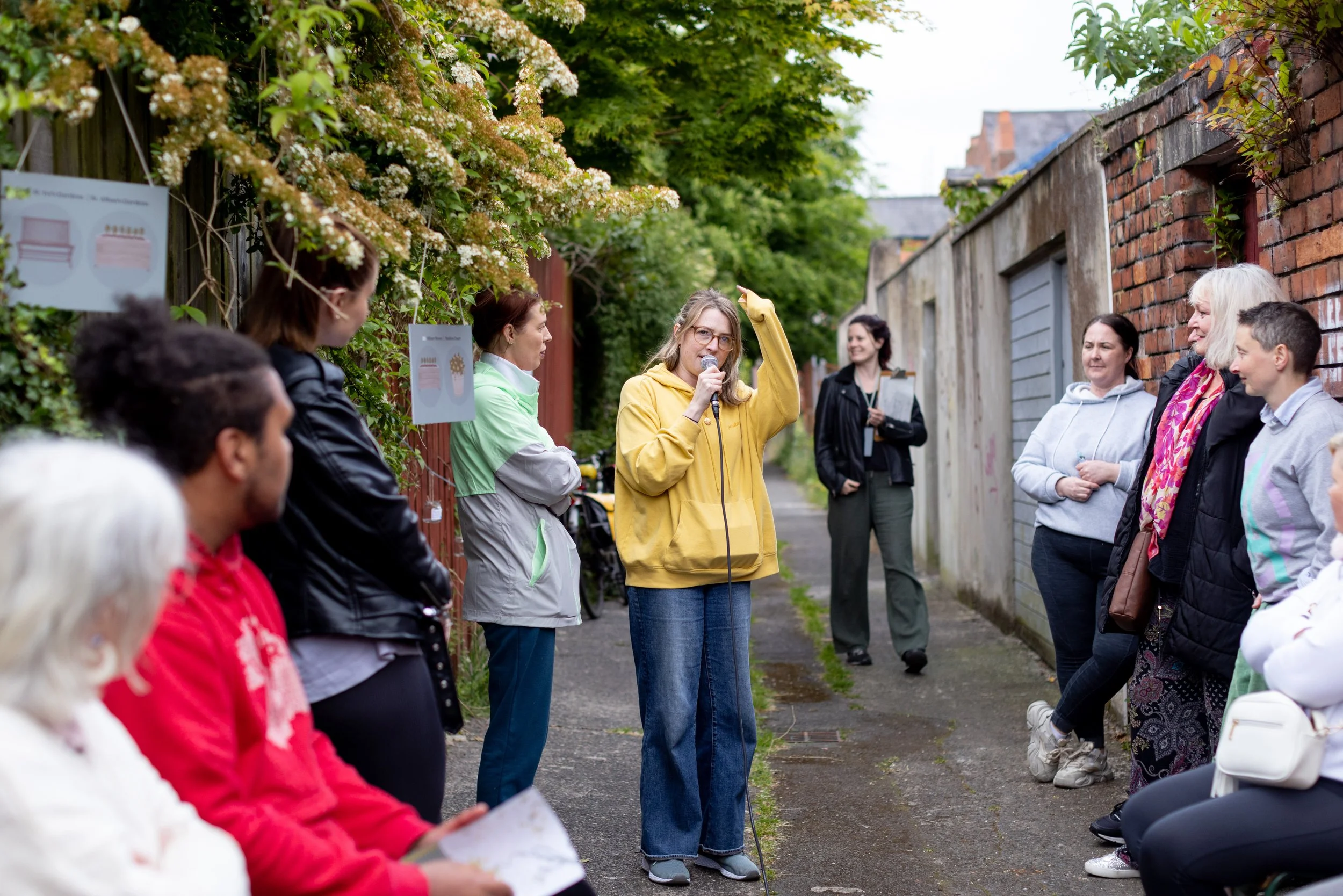
Participatory budgeting for funding for alleyway transformations as part of 9ft in Common, June 2024
You know, one size does not fit all.
Not in alleyways. Not in wards or hospitals.
But the people who REALLY know what is needed are the people that are in those spaces every day. So, I wouldn’t hand the money to one person, but lots of people who know what is needed in their space.
Emma: Fabulous. Thank you very much – the alleyways project sounds brilliant.
How might we design thresholds, and in-between spaces to make people feel safe, secure & connected?
Emma: The next question I’d like to ask you is around thresholds.
I was talking to somebody the other day as part of the festival and we were looking at kind of different words and what different words mean in the context of health infrastructure and we ended up talking about thresholds.
It got me thinking that thresholds - like walls, and the boundaries and lines between places -they’re rarely neutral. I'd like to understand from your perspective what's the design secret from a design around creating porosity between places? From your experience, how do we design thresholds, and those in-between spaces, in ways that make people feel safe, secure, and connected?
Aisling: This is a really interesting question for me.
In my PhD I was looking at Northern Ireland, and Palestine and Israel, and at different types of boundaries - from walls, peace walls, to more intangible boundaries that people still don't cross. So I was looking at different boundaries or thresholds, and how different types of practice - in the broadest sense of the word – can restitch or connect places and people together.
I think walking is a really important practice in general.
Walking is a spatial practice, a practice of making space that anyone and everyone can do.
Once you have walked a route, once you've walked somewhere - from one place to another - you've stitched it together in some way ephemerally through doing that.
Emma: Yeah. I love this idea.
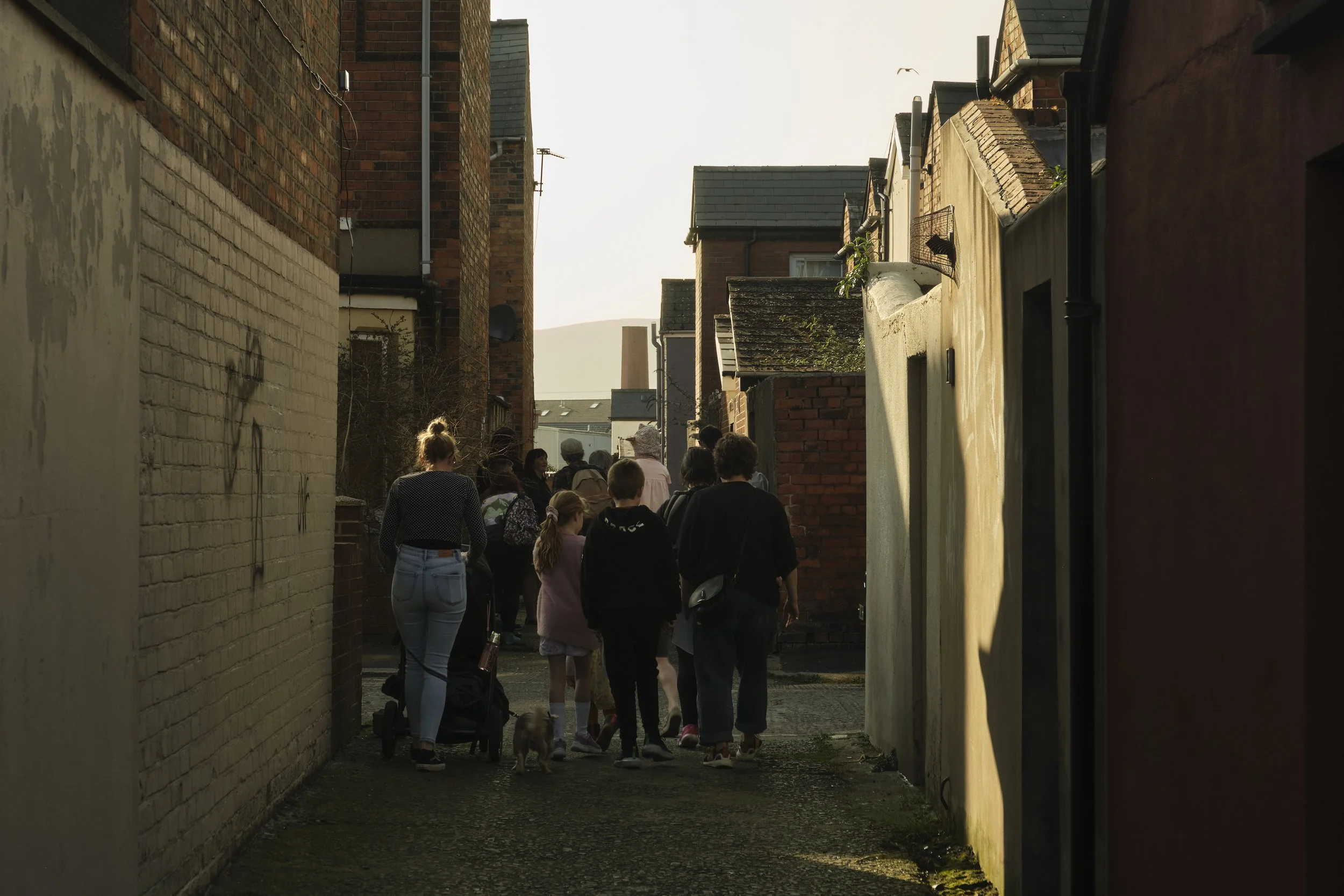
Walking as placemaking as part of 9ft in Common (a tour we led called 'alley au parc', to demonstrate how you could walk safely and peacefully to the park from a residential neighbourhood in South-East Belfast almost entirely via the alleyways rather than the streets)
Aisling: Those places are closer together in your mind than they were before you'd ever done that walk.
A thing I became interested in during my masters, whilst I was looking at the peace walls in Belfast, was that the peace walls in Belfast are bitty. They're not solid - you can go around them, go through them when the gates are open. But they're still nonetheless there as a dividing line, and have been there for decades.
So what are the things that would make somebody choose to cross over to the ‘other side’? I got interested in just cataloguing some of those things.
So, for example where there was a KFC on the Shankill Road, and there wasn't one on the Falls Road, and people in the Falls would go through to the KFC because they didn't have one.
So how to create porosity? There’s certainly something about getting someone to do something for the first time - once you've walked something once, or crossed a threshold once, you know you can do it, and you'll do it again. And it's then also about just having things people want enough to do to cross into another area - you know, make someone say ‘I want to go there’, ‘I want to buy that thing’.
And from an urban perspective, it’s about making things walkable - which is having eyes on the street, good lighting, people about the place, strength in numbers.
I’m not thinking about this question at all from a hospital perspective!
Emma: No, that's exactly what we want. We want different perspectives as part of this and we really don’t want loads of people talking about hospitals.
I’d just like to say that what you’ve articulated there, is such a beautiful way to think about walking. It really is. I just think it's so wonderfully simple, yet so strong.
Aisling: There’s Michel de Certeau, the French philosopher, who in his work ‘The Practice of Everyday Life’, writes about spatial practice, including walking, as tactics and strategies. So jaywalking, for example, is a spatial tactic - a shortcut - as are so many things about the way that you choose to move about in a city. There's real power in walking.
And there's this Palestinian journalist, Bassam Almohor, who says about the power of walking – ‘I walk because my country is small and getting smaller. I walk to make it big again’.
Emma: What a powerful quote.
Aisling: Yeah, walking is really something I come back to again and again in my practice, because there is nothing like walking through a space with somebody, shoulder to shoulder, to really be present and experience it.
Emma: Thank you.
Loads of rapid community projects, or one big landmark development?
Emma: And then finally we are onto the last question…
When it comes to transforming community health, do you think there is fundamentally more power in 100 small and rapid community-led projects or in looking at one huge iconic scheme?
Aisling: Well, I think you know my answer to that by now.
Emma: I think I do!
Aisling: Definitely small and rapid community-led projects. The more the better.
For example, we did a place plan for Banbridge, again with our long-term collaborator Starling Start. We did lots of engagement, spoke as widely as possible to stakeholders - from residents of the town to, you know, public sector, workers, local businesses, anyone who had a say in the town.
We set ourselves a goal of coming up with a hundred actions or ideas from these discussions. And we did! We had over a hundred ideas, and then we sadly had to whittle them down to about 56. But I think this is really important, because the more ideas, or projects you have, then the more likelihood there is that someone is going to be able to see their needs, or preferences, reflected in at least one of them.
One big, grand gesture, or iconic scheme, can take decades. Some people aren't going to live to see them. So in the meantime, make the people who are ‘irritated’ by the reality of today, see something being done about these things. And that can be done with many small projects.
Emma: Okay, so if you take the approach of a small and many - how do you get to a point where you can then bring them together in some way to create weight and depth? Can you/ should you scale an individual initiative, or group projects into something bigger that can then form the foundations for something even bigger again?
I suppose my question is how do you start to build momentum when you've just got lots of small things? What the thing that kind of turns lots of little things into something that's then momentum over time and builds and grows?
Aisling: It's a really good question and there's two questions in one.
There's one about how do you bring lots of little projects into a cohesive whole, or understand them as a whole. Then there's also - if you have to do a big project, how do you take the wisdom of the smaller projects and apply it to the bigger project?
Emma: Yeah.
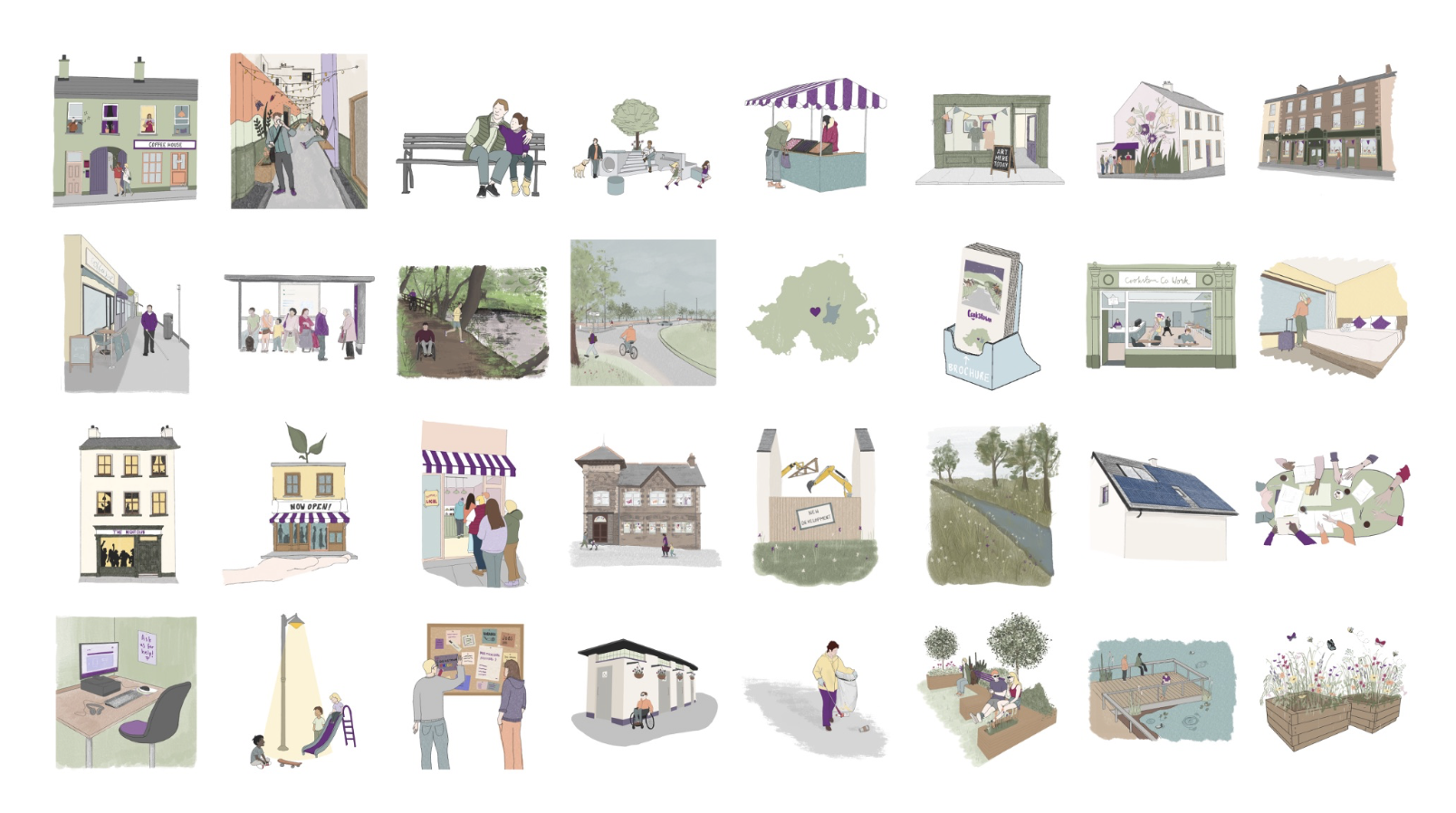
Multiple big and small proposals, each one illustrated, for Cookstown Place Plan
Aisling: Bringing lots of smaller things together can be tricky, but opportunities like participatory budgeting are great, because it allows lots of small things to be connected, but happen organically and then become a conduit for something bigger. And bringing people together and sharing your learning across all those smaller projects then connects them.
In a way that our 9ft in Common alleyways project was like that. There's over 200km of residential alleyways in the city of Belfast. Our project was about small projects, respecting alleyways’ differences, cataloguing them, and also presenting them as a whole that tell a bigger story.
We mapped all of the alleyways in the city for the first time. We listed different things we'd seen, different things you can do, noted this is what we've learned from what we've seen. We piloted different interventions and showed how they worked - how you could put a bench in your alley that folds down from the wall, how you could build a planter and plant things, how you could make a shelter.
And big organisations, public sector organisations, can be an excellent collective holding place for lots of different things going on without amalgamating them unnecessarily.
The other question around how you take learning from small projects and apply it to a bigger one - I think it has to be through having genuine, iterative stakeholder engagement. Not just treating engagement like a tick-the-box exercise – we've shown a few options, we've got two weeks to get feedback on it, and there's no time to actually make any real change because we need to get on to the next procurement deadline.
But instead genuinely having real stakeholder engagement from project inception, or even before inception, talking to the people that know that space best about how it works, what doesn't work, what have we already got that works, what is not being used well enough, what do we need?
Then building a brief, getting feedback on that brief, coming up with options, getting feedback on the options. We do that all the time. That's how we do our place shaping plans, village plans, town plans.
It can be frustrating. It takes longer.
People want different things. You certainly can't please everyone. People change their mind.
You know, it really can be a truly frustrating process. But true democracy is, you know! As someone wise once said - if collaboration isn’t hard, you aren’t doing it right.
Emma: Yeah.
Aisling: It's the process of working out what people genuinely want and being able to justify your decisions - and that's I think the only way to responsibly spend billions of public money on a major infrastructure project.
And, I imagine that's where people like you guys come in and help Trusts with things like that right from the beginning.
Emma: Yeah, and I completely agree with everything that you've just said.
Aisling: Good.
Emma: And as you were talking about how you connect smaller projects, I was thinking that the 9ft in Common example you've just described, and in so many of the things I see, is that things are already inherently connected through the space and the places in which they exist.
And sometimes the missing connection is simply articulating what that is.
Aisling: Yeah.
Emma: Actually there's that innate connection across so many smaller projects – and therefore, through those connections, they have scale already. Is it perhaps that the connection is simply not visible enough?
Aisling: Yeah.
Aisling: There’s been something of an evolution of the role of the ‘expert’. In the past, traditionally people who had formal training in Planning or architecture sat in their ‘ivory towers’ , drew up plans, and that was the thing that got built because they ‘knew best’. And actually the role of that formally trained expert has changed to being gathering up and connecting all of those little different contradictions, and anecdotes, and stories and drawing the learning from that.
That's our role. Take all of those things that contradict each other, find the commonalities, try to understand what is happening on the ground and go from there.
It requires a different type of expertise, dare I say a more feminist one.
Emma: Yes. That is exactly the role of experts I think is needed - and that we fill.
And that feels like the perfect place to end.
Aisling: Okay.
Goodbyes and thank you
Emma: Thank you so much Aisling. It has been a pleasure to chat with you today. I have really enjoyed it.
Aisling: Thank you. Same.
Emma: Have a lovely day.
Aisling: Bye.