
A conversation with Matt Doran
Senior Programme Manager at the National Trust.
Today, I'm joined by Matt Doran, Senior Programme Manager at the National Trust.
We chat about the importance of experimentation over all other things, why places with shared memory cannot be overlooked, why beauty doesn't have to be expensive, and what the National Trust's philosophy of 'used and useful' might teach the health system about its own estate.
Matt brings a perspective that health infrastructure rarely gets to hear. He shares his thoughts on what a ‘National Trust City’ might look like, and made me think about how we might design healthier places if our urban design guidelines started with the Hippocratic Oath….
This is a GOOD one. It went in all sorts of directions I never expected – via Stockholm, various National Trust initiatives, and ended up in a shopping centre!
Grab a coffee, and join our wrong conversation.
Not enough time right now? Find a snapshot of our conversation here
The longer read
(Grab yourself a coffee - this is a longer chat, but it is SO worth it!)
Matt: Hello.
Emma: Hi. Please can you introduce yourself, Matt. Tell me who you are and what it is you do, please?
Matt: So, I‘m Matt Doran. I am a Senior Programme Manager in the National Trust, and essentially my role is looking at how the Trust can deliver its charitable purpose outside of ‘business as usual’, particularly in urban areas.
Emma: And what would you say are three words that describe what you do?
Matt: I've got five…
Emma: Five is fine. We love a bit of rebellion against the questions!
Matt: Challenge. Create. Test. Fail. Learn.
I think that would probably sum up my job in a nutshell.
Emma: I love it! It sounds quite similar to my job in many ways.
Matt: We've both got good jobs then!
What does a healthy space mean to you?
Emma: So, we'll start with a question around healthy space. What does a healthy space mean to you? Have you been in one anywhere in the world? What does it feel like, look like, sound like?
Matt: So, I've got two thoughts on this one. One is the direct answer to the question and one is a sort of metaphorical answer.
So the direct one is I was in Stockholm recently, and that is what I would describe as the best example of a healthy city. It was so clean - the air was clean, there was very little traffic. There were so many people moving around by means other than being in a car. There was green space everywhere, and it was really, really high quality, beautiful green space. It was just invigorating.
So that, for me, would be the direct answer to the question.
But then the question got me thinking - what if you took the Hippocratic Oath and applied it to a place?
Emma: Interesting…
Matt: I know this isn't a direct quote from the original Hippocratic Oath, but the ‘do no harm’ aspect of that - how would you design that into a city? How would you take all of the fundamental principles and translate that into an environment?
And I don't know the answer to that, but I just thought that was an interesting way of thinking about your question. I dare say you could write a PhD thesis on that!
Emma: Yeah. That's so interesting. Taking the Hippocratic Oath as the starting point I think is brilliant. Love it.
What one thing should we stop doing today to improve health by 2040?
Emma: Okay, now if we're going to start building a genuinely healthier society by 2040, what's the one thing that you think we should completely stop doing today?
Matt: So, I've got a long list of these, so I'm not quite sure I'm going to manage to boil it down to one, but I suppose it would be to stop trying to solve today's problems with yesterday's infrastructure.
Think about what 2040 is going to look like, what are the issues are going to be, and what is the infrastructure that is needed to resolve those? Because infrastructure is one of those things where, by and large, if you're creating it - it's really slow. So really thinking forward to design in options and flexibility to respond to future challenges is what's really, really important.
There's a little subset of that for me then which is to stop being wholly constrained by KPIs.
KPIs tend to tether attention, focus and energy to the past – the reasonably recent past. And KPIs do have their role, and you do have to use them to check on progress.
But, if you only ever focus on KPIs, you never have that space to start experimenting a little bit, to start talking with partners about what might be possible or to have that open-ended exploration of what might be a better way. So yeah, it's that exploration space that is important, and KPIs can smother it.
So now the third part of my ‘one’ answer…
That’s to stop thinking of health infrastructure as bricks and mortar that you own. So you may yourself not own the health infrastructure, and it may not be bricks and mortar – both those things are really important.
In fact, if you think about it, it's a bit like matter and dark matter. There's probably far more health infrastructure out there that you don't own, than the stuff that’s yours – and that’s had all the attention and focus.
Emma: Yeah. Wonderful. Thank you for that triplet of answers (I did say as well these questions to be interpreted in whichever way you want!). Also, I love your answer referencing dark matter – I am a huge proponent of focusing on the dark matter of health infrastructure.
If you could give someone outside the NHS a budget to do something with a space, who would you give it to, and what would you want them to do?
Emma: Now, if you could hand a chunk of budget to somebody who sat completely outside of the NHS, and the health system, to do something with a space, who would you give it to and what would you want them to do with it?
Matt: It's not a direct answer to this one, but I would create an incentive first, and then just see what health infrastructure emerges.
The example I've got is green space access payments scheme - which is a novel idea my team are experimenting with at the moment.
It was an idea conceived in terms of a cityscape. I was looking at Sheffield, which has got something called the Five Weirs Walk along the River Don – a beautiful river, or what could be a beautiful river walk. But there’s a large section of it where it’s very closely bordered by heavy industrial estates, leaving just a tiny little footpath right next to the water. If the area was more attractive, it could be a fantastic health asset, but it’s not that well used at the moment. And actually, if an economist looked at the amount of money that was being earned by those industrial estate owners from the scrap of land they have near the water, it would probably be next to nothing – it is low value land being used to store skips, or piles of aggregate.
But what if those land owners were offered an incentive - what if you take a 15-20 metre buffer zone next to the path, turn that into an accessible green space, and give them a micro payment for every single person who walks along it? The businesses and landowners would earn far more from people walking along that newly created healthy infrastructure than they would from storing their skips on it.
Emma: Yeah.
Matt: And in a sense, they haven't had to do very much - so long as it's reasonably attractive and of a good quality, it qualifies as green space, you get paid per person. But, the incentive works because you make the owner of that infrastructure start looking at their land and thinking, I could earn even more from this if I made it even more beautiful.
And then, what about if I joined up with my neighbour and they made their bit beautiful as well? And then all of a sudden, you have more and more people coming and they're earning more and more from it. And you have organically grown health infrastructure without actually having to do any of the hard yards in terms of the creation. You create a market economy in generating health benefits - simply through offering a small incentive.
We’re experimenting a little bit with this concept at the moment on the edge of a city with farms and fields, and just saying to farmers - are you interested in doing this? And we're just starting to learn what works.
This all comes back to taking that experimental approach.
We're learning which are the types of spaces that drive lots and lots of people through them, and what doesn't work. And the farmers we're working with are learning as well. And they're starting to say things like ‘if I planted a bank of wild flowers along here then that would be really beautiful and perhaps more people would want to come and see those’. So, why don't I do that? Because the cost of that is minimal compared to the amount of money that I could then earn from people gaining access - and then there are the wider health and wellbeing benefits both physical and mental from that.
So I would use funding to develop experimental and scalable incentives rather than taking a physical space and doing a particular thing to it.
Emma: Fab.
How do you make people fall in love with buildings and places? What about health buildings?
Emma: The National Trust has spent decades making people fall in love with places. What do you think it would take to make people fall in love with a health building? And do you think that is a realistic and reasonable ambition?
Matt: I think that people form all sorts of attachments to different places. And those attachments are not necessarily related to the reasons that the place was created, or the reasons that you as the organisation think it's important.
One of the lessons from the National Trust is to be inquisitive about why a place matters to the people, and not to assume that it matters to everyone for the same reason that it matters to you.
The other part of the answer, and this is really obvious in a sense, but is that beauty matters. It really, really does. But it's also really easy to design it out when infrastructure gets built – it is very often the victim of value engineering at the end of construction and/or isn’t maintained so ebbs away.
Emma: Mmmm, very often.
Matt: Beauty makes such a difference to how the infrastructure delivers its purpose, and the benefits it gives to people. Beautiful places matter in a really profound way - and obviously greenery is a huge part of that, as are the materials that are used, and the design of a place.
Emma: I think there's definitely a common perception that ‘beauty equals expensive’, and as you say it does get value engineered out. What's your view on this preconceived idea that beauty is expensive? Do you think that’s true or not?
Matt: It doesn't have to be. But what you do need is a bit of time and imagination. In a pressured busy world, what tends to happen is you copy and paste from the last job. And then retrofitting beauty onto whatever you’ve created can be really difficult, and more expensive.
But if you start with beauty in mind, it doesn't have to be more expensive. And sometimes it can be a great deal cheaper. Particularly when you're looking at green space and greenery - and not just expense in the capital build, but in terms of the maintenance and ongoing costs.
I was looking at some skyscrapers in Manchester the other day which are all glass and steel. In the heat wave we've been experiencing, I was thinking that the energy that is required to air-condition that building (if it is air-conditioned) must be extraordinary! And yet, there are so many more ways of cooling a building that can be both beautiful and really cost effective.
But beauty does require a mindset change in construction companies, and for clients to actively say that I want this to look really, really attractive.
Emma: Thank you. And thanks for bearing with me…I went a bit off-piste there.
What might a ‘National Trust City’, or town, or neighbourhood, look like?
Emma: You may have a different view on this, but as an external person it does feel like most people carry the assumption that the National Trust is about the ‘past’ and country houses, big parklands, and outdoor landscapes.
I'd just like you to chat about some of your thoughts on what does/ could the National Trust’s charitable purpose look like in terms of a city centre? How does it translate to a smaller urban environment, a high street, or next to a GP practice?
Matt: Well, the National Trust is a charity that's been going for 131 years. It's a long time and its charitable purpose is actually really broad - it is basically to provide benefit to the nation from places of historic interest or beauty.
Obviously, all the country houses, and upland/ coastline that the Trust looks after and provides access to, and the visitor model that we've got is super important – the Trust does that work really well, and always will do.
But what we're doing now is question - what should we be doing as well as that?
Because we know that just relying on those assets alone won't deliver the Trust’s charitable purpose to everybody in the country. So, what delivery looks like of the Trust’s purpose in other areas is actually a very live question at the moment - it's the reason my job is so interesting and exciting as there are lots of possibilities.
To answer the question, if you applied the National Trust’s philosophy, then what might a ‘National Trust City’ look like?
Well, it would be an enormous step change in the amount of greenery and nature in a city. And I don't just mean a bit more - I mean a full on, enormous shift (and uplift) in the amount of green space that surrounds people in their daily lives. And from a health point of view, that's really important because the more natural an area, the healthier people are both mentally and physically - there are libraries full of evidence that point to that, for example: the impact on the immune system from microbes in the soil; to how clean the air is; how the temperature is mitigated; to the phytoncides - chemicals released by trees - and their impact on mood.
The challenge the health sector's got here is that it doesn't have the tools to create that type of infrastructure, nor does it control any of that type of space and it doesn't know how to deliver improvements within it.
But I would say, okay so let's talk then let's find out how we can start to think about this together…
Emma: Okay, so the health system doesn't have any control over so much of the ‘healthy infrastructure’ out there, but do you think it knows how to actively influence it, or not?
Matt: There will be individuals who’ve done great work on this, but at a sector level, I think it’s too conventional. I suspect that it seeks to influence in a gentle, almost differential way, and it probably puts forwards its opinions via various existing process, and through Local Plan development, and things like that. But imagine, if it was urgent, if it really needed to do some of this right now over the next year, what would it do? How much resource would it put into it? How bold could it be?
At the moment, I get the impression that it's one of those things that sits as a side issue because of wider NHS pressures. But the solution to that is go and talk to partners who do know about this stuff and let's spend some time coming up some interesting ideas that we can test for real.
Emma: Anything else in a National Trust city?
Matt: As well as a fundamental change in the amount of green space, the other thing it would have is a higher priority on historic places that have shared memories.
Everybody remembers where they first went to see their first film. Everybody remembers where they learned to swim - you can probably still smell it, recall the sounds or tiny details about the swimming baths.
I think there are certain kind of touchstones within an urban landscape that mean something to lots and lots of people. And they are quite often historic properties, even if they're not the grandest or the very oldest. So, I think there would be an emphasis put on those sorts of places, finding new purposes for them, that can help bring people from different walks of life together.
I think that is hugely important particularly in today's world (I sound really old now…) where people are on smartphones where your attention is captured constantly, and there’s a sort of bilateral relationship between you and your algorithm. A shared space gives you a connection to somebody who you otherwise wouldn't meet - and I think that's a special role that heritage and built infrastructure can play in the future of cities.
Emma: I totally agree.
I love that idea of spaces having shared memories, and it makes me think immediately of health. We find that when people want to close old hospitals or health centres, that the clinical case is watertight. The estate is poor quality and services move somewhere much better - so clinically, it's the right decision and makes total sense.
But, there is usually consistent underestimation of the fact that that old crumbling building itself is an important place - full of shared memories, full of meaning - and nobody is curious about it. And that can be true whether it is a Victorian build, or a 1960s pre-fab. And there's something in that I think the health system really needs to learn from, specifically about its own estate.
Matt: And the health system has the additional problem or challenge that a lot of its infrastructure can feel quite, I don't want to say ‘threatening’, but institutional – uncomfortable, slightly imposing.
Emma: Yes. And then looking at its older estate, a lot of it has has complex histories. Many hospital sites are ex-workhouses, or mental health facilities are ex-asylums – there are a lot of spaces that don't sit comfortably as part of a 21st Century health care system.
So there's always going to be a tension, I think, between the memories that people hold of places and the places themselves.
Matt: The National Trust owns a workhouse in Southwell, Nottinghamshire, which later became sheltered accommodation and an infirmary. When we were preparing to open it, many people really want to share their memories and connections to it – either directly of later uses or what their grandparents had told them about when it was still a workhouse. People feel a certain pride or duty to share some of the ‘bad’ stories as well as well as the good stories, but you have to create an environment where people feel comfortable sharing that.
Emma: Thank you.
How do we navigate the tension between the preservation and activation of spaces?
Emma: So, the next one is around the tension between the preservation and activation of places and spaces. I'd like to get your view on whether that tension exists?
Matt: Yes, that tension exists and I would say that it exists across the heritage sector as a whole.
Partly it's a logical tension because heritage can't very easily be created - once it's gone, it is gone. That makes it unlike nature which actually can regenerate and is in itself a dynamic thing, where if you create the right conditions it can come back. But that's not true of heritage.
There is also tension partly because of the huge passion of people within the sector - which is one of the best bits about the heritage sector! People really, really care about it and that's super important.
But there is also a growing realisation that as a charity we exist to give benefit to the nation from places of historic interest. So what actually is that benefit? And how much benefit are we giving from those heritage assets? And could we give more without disproportionately impacting on the preservation? The boring answer to that final question is that it depends - some places are more vulnerable to particular types of uses than others.
One of the aspects of our new strategy in the Trust is places being ‘used and useful’.
So, we're looking for ways in which historic assets can be used in a variety of different ways, and be useful to people, rather than solely being a thing for a visitor to come and look at. And I think that is being echoed across the sector as well.
Emma: And there is another layer here, too? Without spaces being used, you're not really able to do the preservation. I don't make that point specifically regarding the National Trust, but in order for anything to have any form of longevity and be preserved, you've got to be using it in order to generate the case (or in many instances the money) to keep it going.
So you're always going to have that as an underpinning tension.
We see that in the use of say, green spaces on hospital sites as an example. It's the same thing – you need to use it or lose it. Often people will be told they can’t use that space because of there's all of these risks, but ultimately then it either falls into disrepair, or sometimes land gets sold that gets developed.
Matt: Yeah.
Emma: So it's interesting, even though it’s a completely different sector, it feels like a really similar theme.
Matt: Absolutely. And that sort of financial, or prioritisation, imperative is really important. Unless it is pulling some money in, or is seen to be important, it becomes vulnerable to either being disposed of, or just degrading away and being useless. So there has to be a mindset of; how can this be more useful? How can it deliver more? And then really experimenting with that.
Experimentation is a real theme for me, I know - but trying stuff out is just so important.
You can't sit in a meeting and come up with the answer. You might come up with a few options, but the only way you'll actually find out if anything works is by doing it, then reviewing it and saying – ‘okay, this is how we think it can go now’.
Emma: And that's why I loved the choice of one of your words that describe what you do – fail! Because if something fails sometimes, it's fine. I think people are too scared of failure. Not everything that we're going to try is going to work. And there is nothing wrong with that.
You can't experiment or innovate without the willingness to fail. It's impossible.
Matt: Absolutely. It's fundamental.
In almost any kind of leap forward that humanity has ever made, failure has preceded that. Thomas Edison epitomised this – paraphrased into ‘I failed my way to success’ It's only by getting it wrong that you learn what does work.
Emma: And do you think for big institutions and organisations like the NHS, where there is often less space and scope to experiment, that their approach should be to start small? Rather than having to always start with the big project, do you think more attention should be put on the small stuff?
Matt: 100%. Because that derisks failure.
So, one of the key things that holds particularly big, slow institutions like the NHS or the National Trust, one of the things that holds those institutions back is that kind of reputational risk, that fear that they're going to do something and everybody's going to hate it, or it will be seen as a waste of money. The ‘tyranny of KPIs’ also comes in here as they crowd out funds and energy for things that are being measured for quarterly progress reports…
One of the ways of de-risking that is doing it small scale - although there is a caveat to that which we'll come back to.
The other easy way of de-risking it is by working in partnership because you're sharing the risk.
The caveat to ‘start small’ is that innovation can be very easy – but then the adoption of innovation is difficult.
So there almost needs to be some kind of ‘innovation adopter unit’ that says, okay we've seen enough now from this small scale pilot - our job now is to do it in a thousand places. Too many small scale innovations don’t have that focused organisational momentum behind them so it just withers away.
People will say, ‘Do you remember that really interesting thing we did five years ago? It was brilliant, wasn't it?’, ‘Yeah, it was fantastic’, ‘Whatever happened to it?’, ‘I don't know’. And that's because there isn't any institutional accelerator.
Which in the business world you have now, don't you? Universities as well have put much more emphasis on this now. And I think the health sector, and my sector, are starting to recognise that importance of putting enough weight behind the growth of great ideas.
How do you create a sense of belonging in places? And why does that matter?
Emma: And then finally… In your opinion, what does a place have to do, to make people feel like it belongs to them, rather than belonging to an institution?
Matt: So my challenge to this question is I don't think it has to feel like it belongs to people for people to enjoy it.
‘Belonging’ is one of those phrases that is used quite a lot - but I'm not entirely sure I'm convinced you need that in order for people to feel what you want them to feel. So, I think places have to feel really welcoming and comfortable. You have to feel like this is a place FOR you, rather than necessarily it belongs to you in any way.
So for example, my local park, I've been going to it for 25 years, but I do not feel it belongs to me at all. Is it really important and special to me? Absolutely. It's about making sure that people are comfortable in places, and they feel welcome, and they feel it is a place that they're allowed to be.
And the way you do that is again, it comes back to our last conversation, is you experiment. You try stuff out. You talk to people and you find out what is it about this place that you like, and can we do more of that? What is it you don't like about this place, and how can we mitigate that or remove that?
Emma: Yeah. Do you think then that sometimes in collaborative design that that the emphasis can be too strongly on trying to design a space that belongs to people as opposed to designing a space that people feel like they belong in?
Matt: I really do. And I think that there is a challenge here, because designing a space that brilliantly suits one person will definitely not feel like a place that suits somebody else.
Emma: No. Absolutely.
Matt: And we often talk about ‘communities’ in the singular. But we know that there are differences within demographics in terms of what feels comfortable or not – some people feel really quite uncomfortable with more naturalistic spaces when it comes to green environments. So it's about designing a space where as many people as possible can be comfortable.
Emma: So thinking about collaborative design and co-design, I just wonder do you think that sometimes we are getting it wrong? Is it becoming formulaic and therefore have we lost something?
Matt: It's a good question and I don't think I know the answer. Though as with all things, the more often processes are repeated, the more formulaic they become, because people short circuit things, don't they? And it can start to become performative rather than instructive.
I think that there's also an important element in good community-led design, and you can't do this in everything, of seeing how people use something before you finalise it.
So there's two examples of this I can give you.
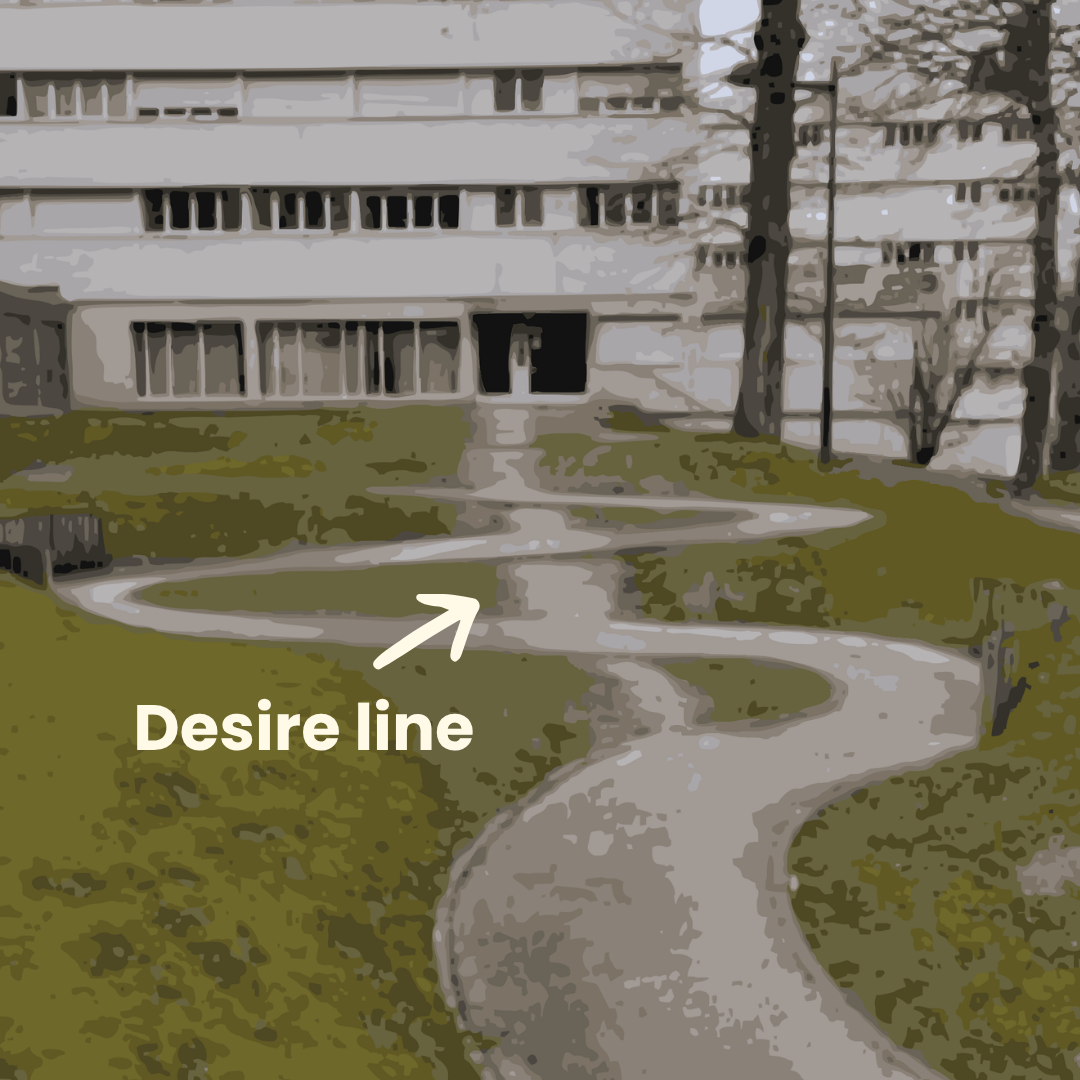
Frist, I've got this brilliant image of this winding path to an apartment block. And you can tell the landscape architect thought they’d designed something fantastic because the path wound its way round – but then a well-trodden desire line has just cut right through it. And it just makes me laugh every time I look at it because it is a classic example of how much better things could be if we just observe how people will actually move, and then built stuff around that.
Matt: Second, this comes back to ‘the used and useful’ idea of how heritage can be of use?
One of the things that we're exploring at the moment is whether we can create with partners something we're calling a Safe Harbour Scheme, for places like cinemas, swimming baths, libraries,. The types of places where structurally they're okay, but other than making them what we call ‘wind and water tight’ you don't restore it. You just allow different organisations, community groups, social enterprises in to use the space however they want to. You then see which works the best, and then you can transfer the building to those organisations that are the best fit for the space.
Then you can restore the building around how they're using it, which is the opposite of what normally happens - which is where you come in and you say, ‘Right, this is what the master plan looks like. This organisation is going to own it.’ And then five years later you can find they're really struggling.
So, there is an experimental design phase that can be factored in right at the start.
And there are certain sectors that are brilliant at that meanwhile space use!
The creative sectors, the art sectors – they can do extraordinary things with a tenth of the budget that an architect or a civil engineer might need. And actually, from the perspective of the people using the building, it will look fantastic.
Emma: Yeah.
Matt: It's amazing what you can do with temporary pop-up stuff to just get an idea of what would work best, and THEN you can do the heavy lifting in terms of capital investment afterwards.
Matt: Can we go back and touch on the question about other sectors?
Emma: Yeah, of course
Matt: At the moment there is a ‘crisis’ on the high street, everybody's getting vexed about the lack of shops. But from a health sector point of view, I'd be saying, ‘Brilliant, this is where people are. Now is my opportunity to acquire spaces so I can take health to them’.
And I think that for me, that is one thing that the health sector could do more of - think about where people are comfortable being, and focus more on how do we get services to those spaces? How do we introduce health in those spaces? Particularly for things like screenings, or blood donation.
For example, if there was blood donation in my local shopping centre, I would be giving blood all the time. If you make me book somewhere like a hospital or inconvenient location, it becomes a chore. Retailers in the commercial world have understood for eons that convenience is king - it far exceeds cost and other factors. So that's a principle that is surely also true for the health sector?
If you want more people to be accessing a service, you have to go to where they are.
Emma: Can I just ask you a question on that? I'm doing a bit of work at the moment around health and the high street and looking and the use of language and visual narratives.
So I completely agree that the opportunity is absolutely massive for health and high street, but I think that the risk is that you end up with people simply fitting out buildings as health centre or mini hospitals. And my question is - does that fit on a high street, or HOW does it fit on the high street?
Because the language of retail and leisure is very different, so I’m interested to think about and consider how you translate a health space into a high street setting. What does that feel like? What does the health sector need change? How does it build on that idea of convenience?
I really don't think you should just go and park a big health building in the middle of a shopping street, whack that big blue NHS sign on it, and put a lot of blue vinyl flooring in, and think that is some sort of radically innovative plan.
I mean just the conversation we've had all through this is don't just do the thing you've done before – and this is the perfect opportunity to rethink health.
Matt: It's a really good question, isn't it? And I think again, at the risk of repeating what I said before, the answer won't necessarily come from within the health sector. So I would say go to others to design what that language should look like and to physically design it as well.
Because there are kind of psychological responses to that traditional ‘health building’ which you really need to consider.
People, often particularly men, can be really uncomfortable going into an exclusively health space. Mixing it with other things on the high street, and doing it in a humorous, kind of lowkey way, would probably be quite important. Like capturing people when they're stood around bored. This is not a sensible suggestion, but ideas like having blood donations next to changing room waiting areas. Or in barbers. In spaces where health can be dovetailed into the rest of the environment.
Emma: You could set up retro film or TV screenings as part of blood donations? That'd be easy enough to do. Just get a big projector in!
Goodbyes.
Emma: Okay, on that note, we are way over our allotted time. So thank you much for your time today - our extended chat has been absolutely wonderful.
Matt: No, that's alright, I’ve really enjoyed chatting to you.
Emma: It’s been great to have this conversation with you today. Enjoy the rest of your week.
Matt: Cheers. You too. Bye!